The study investigates an unusual brightening of a star. The ICCUB –IEEC astronomer Josep Manel Carrasco is one of the authors of the study.
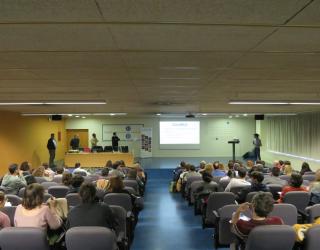
The first training day of the course Activities with Medipix detectors to investigate Radiation in the classroom, (ADMIRA project) took place on the past Friday, January 10, at the Aula Magna of the Faculty of Physics.
At the end of the First World War, physicist Ernest Rutherford carried out a series of experiments consisting on bombing nitrogen atoms with alpha particles. He saw the appearance of a radiation which was less ionizing than those particles and with a greater range.
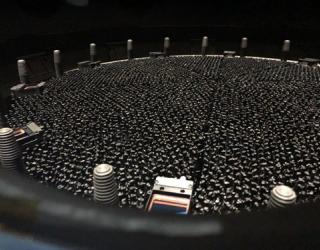
The night of October 22-23, 2019, a new instrument installed in a telescope in Arizona made its first light observation pointing its 5,000 eyes of optical spectra to the cosmos. The device, which will observe a record figure of galaxies and quasars, tested its unique vobservation of the Universe.
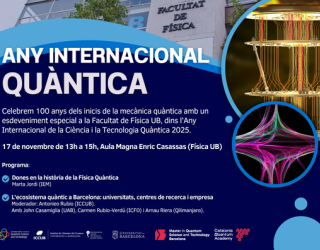
The year 2025 has been declared the International Year of Quantum Science and Technology (IYQ) to commemorate 100 years of the foundations of
European Researchers’ Night is a science outreach event held simultaneously in over 400 cities across 30 European countries, supported by the European Commission through the Marie Skłodowska-Curie
In this outreach talk on dark energy, we'll explore the depths of the universe to understand one of its greatest mysteries.
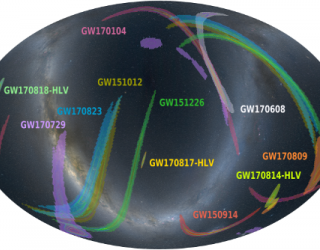
In 2015, a new window was opened to observe the universe: the first signal of gravitational waves was detected on Earth. What are gravitational waves?
On the occasion of the anniversary of the publication of the Einstein's article about the General Theory of Relativity on December 2, 2015.
3rd time of the program, minute 3
Guide to perform an activity of modeling the atom using cooperative work and personification, in order to introduce the students of ESO and / or the bacc
Here you will find documents with information about Timepix, the manual of the PixetPro program and a small introduction to the nuclear physics, among others.